
How Multiwrapper Technology and Region-Specific Localization Are Transforming Global Learning
 |
|
5 mins read
|
|
5 mins read
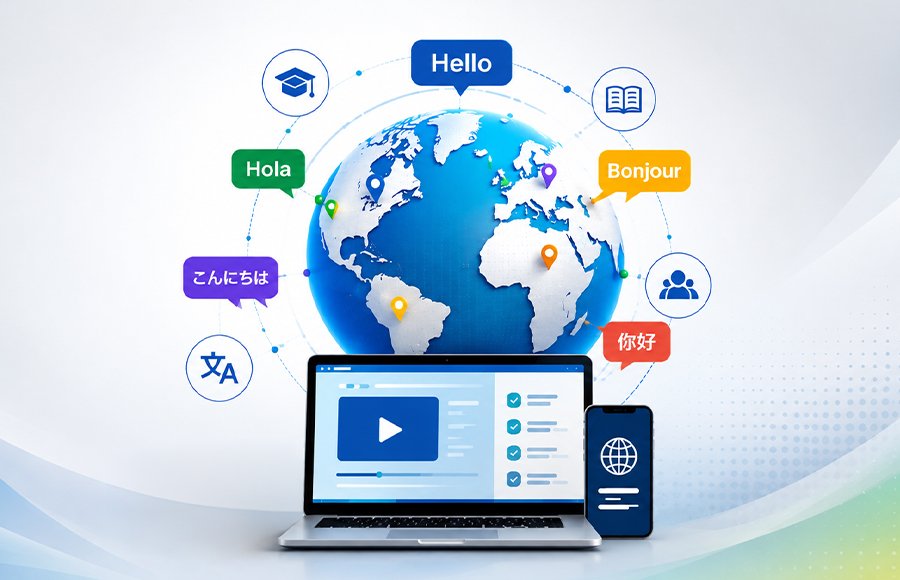
With the global expansion of businesses, there is an increasing need for companies to offer training that suits a wide variety of audiences. Individuals prefer content to be offered in their language of preference, and adapted to their local context. Modern eLearning technologies have come up with ways to meet this need by offering multilingual services, multiwrapper options and region-specific translations.
Why Multilingual eLearning Matters
A global audience doesn’t mean a one-size-fits-all approach. People can understand better when the training materials come in their native language. Multi-language e-learning can help in understanding, completing courses and building an inclusive learning environment.
When it comes to onboarding staff from around the world or educating global clients, language becomes the only way to success.
Benefits include:
- Increased learner engagement
- Better knowledge retention
- Improved accessibility
- Consistent learning experiences across regions
- Increased adoption of training programs globally
Expansion of Global Reach
Organizations functioning on an international scale are usually plagued by the problem of having to maintain several copies of the same course. Any changes or updates must be applied to each language version separately, which is expensive and tedious.
Modern eLearning solutions eliminate this challenge by enabling businesses to create one course that serves learners around the world.
Thanks to modern technology, organisations can scale up their training rapidly and consistently.
Multiwrapper Tool and Simplified Content Management
The multiwrapper technique is designed to make the delivery of multilingual courses easy by incorporating various language courses in one single bundle. Rather than having different courses in English, French, Spanish, German, and Japanese languages separately, there would be only one centralized learning course for all the languages.
There are many benefits to the above-mentioned strategy:
Centralized course content management system
• Easy and quick course deployment in various markets
• Easy update and maintenance process
• Development cost savings
• Course branding consistency
How a Multiwrapper Tool Works
The Multiwrapper Tool is a great solution to facilitate multilingual eLearning as it allows delivering courses in different languages using one course package. First, there is the development of the master course in the source language, and further all translatable elements (text on-screen, navigation texts, assessments, audio scripts, feedback messages) are extracted from this master course for translation and localization purposes.
The translated and localized content is then incorporated into the course to create a single multilingual package containing all required language versions.
After the multilingual package is loaded in the LMS, the learner can launch the course in a pre-defined language or select it manually. At the same time, the course structure, interactions, and functionality will be exactly the same for any chosen language.
In case if some updates are needed, there will be no need to perform changes separately in all languages, the changes should be made in the master course and then the multilingual package is re-created again.
Workflow Overview
Master Course Creation → Content Extraction → Translation & Region-Specific Localization → Multiwrapper Combines All Languages → Single Multilingual Course Package → Upload to LMS → Automatic or Manual Language Selection → Consistent Learning Experience for Every User → Update the Master Course Once and Republish Across All Languages
With such an efficient workflow, the developers will find it easy to develop, version control becomes easier, costs of maintenance reduce significantly, and the organizations can scale up their multilingual learning processes without fail.
For example, an organization planning on implementing cybersecurity training for their employees in 12 different countries. The Learning and Development Team will have to deal with 12 different courses without the Multiwrapper Tool, but with it, they can create a master course and translate it to 12 different languages, and then publish it as one multilingual package.
Employees get the course in the language they prefer automatically, while the administrators take care of only one course in the Learning Management System (LMS).
Region-Specific Translation Goes Beyond Language
Localization goes beyond direct translation. It involves translating material in such a way that it fits within the context of the local culture, terminology, laws, spelling rules, and expectations of the learner.
For instance:
• The spelling and terminology of English (US) differ from those of English (UK).
• The Spanish used in Spain is different from Spanish used in Latin America.
• Compliance training typically involves country-specific legal details.
• Dates, currency, units of measurement, and examples may vary from region to region.
One Package, Multiple Languages
Multilingual learning management does not necessarily imply managing many different courses. Through the use of a single package, organizations can:
• Provide many language options in one course
• Ease LMS management
• Limit storage needs
• Maintain version consistency
• Fast track deployment on a global scale
This centralized approach saves time while ensuring every learner receives the latest content in their preferred language.
Future-Proof Your Learning Strategy
Multilingual learning becomes indispensable as organisations extend their operations internationally. Organizations that adopt localization techniques will be able to accommodate more learners and satisfy them to a higher degree while reducing maintenance costs.
Combining multilingual capabilities, multiwrapper technology, and region-specific localisation enables organizations to create a scalable and efficient global eLearning strategy.
Conclusion
Language should never be a hindrance to learning. Contemporary eLearning solutions allow enterprises to provide quality training consistently in all the countries and regions of the world without developing multiple versions of the same course. With the use of multilingual solutions and advanced content management systems, organisations will be able to go truly global and provide each learner with a personalized solution in the native language and region. This is the basis for truly scalable, comprehensive and future-proof learning.
Related Articles
View All
Why A One-Size-Fits-All Approach Fails In Global eLearning
 •
Sep 22, 2026
•
4 mins read
•
Sep 22, 2026
•
4 mins read

Cloud-Native eLearning Platforms: A Guide To Scalability And Security
•
Sep 8, 2026
•
5 mins read